The Product Behind the Viral Map
We talk a lot about Product-Market Fit.
But Unseen Bangladesh made me think about something else.
The product didn't go viral. The content it created did.
If you're reading this from outside Bangladesh, here's the context.
Bangladesh is divided into 64 districts across 8 administrative divisions. For many Bangladeshis, travelling across these districts is a personal record of where they've been, what they've seen, and what parts of the country they still haven't explored.
Unseen Bangladesh is a travel-focused web platform built around that idea.
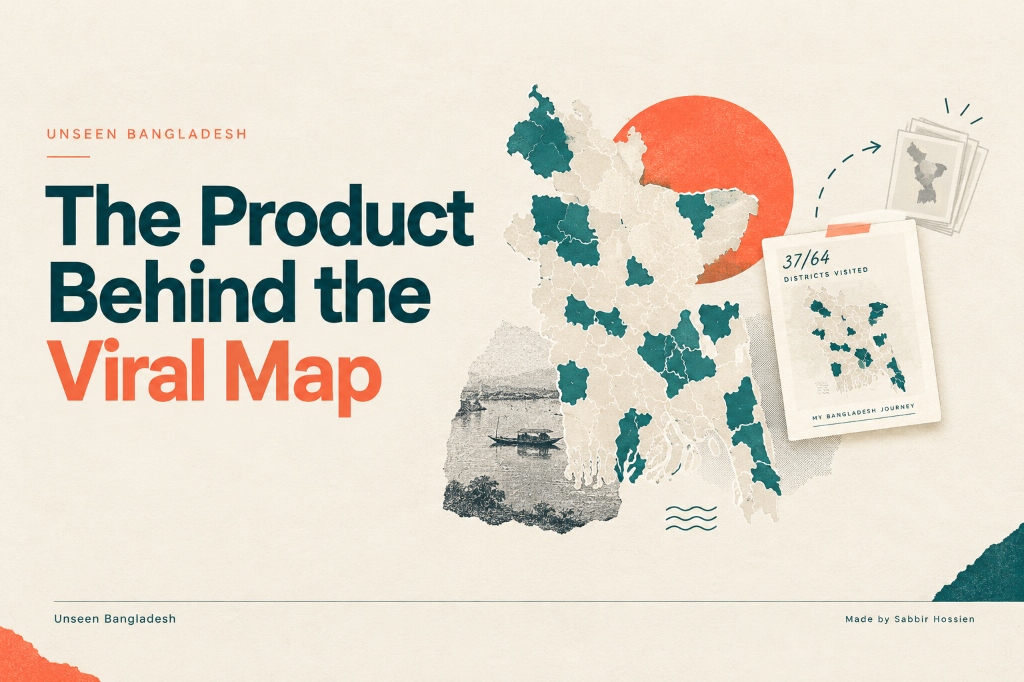
Its most talked-about feature is surprisingly simple: select the districts you've visited, choose a visual theme, optionally add your name and photo, and generate a personalized map showing your travel history. The map can then be downloaded as an image or PDF and shared.
The platform itself goes beyond this feature. It also includes travel guides for Bangladesh's districts, a trip planner, quizzes, a map puzzle and a leaderboard. But in early October 2026, it was the personalized travel map that started spreading across Bangladeshi social media.
The creator, Md. Sabbir Hossain Robin, describes the project as something he originally built out of personal interest. He enjoys travelling and came up with the idea while trying to create a map of the places he had visited himself.
That origin story is interesting.
But what really caught my attention wasn't the story behind the product.
It was the distribution loop hidden inside the product itself.
The product didn't go viral. The content did.
Think about what normally happens when you use a product.
You open it.
You do something.
You get a result.
And then you leave.
Unseen Bangladesh changes the last part.
You don't just use the product and receive information.
You create something that represents you.
That distinction matters.
When someone selects 23 out of Bangladesh's 64 districts, the resulting map isn't just a functional output.
It says:
"These are the places I've been."
Someone else sees that map in their Facebook feed and immediately has a reason to interact with it:
"How many have I visited?"
So they open the website, create their own map, and share it.
Now their friends see it.
And the cycle repeats.
That's a very different growth mechanism from simply putting a "Share" button on a product.
The viral loop was inside the product
The basic interaction is almost embarrassingly simple:
Select → Customize → Generate → Share
But look at what happens after that:
Use the product
↓
Create a personal artifact
↓
Share it
↓
Someone else sees it
↓
They compare themselves
↓
They want their own map
↓
They use the product
The user-generated artifact becomes the distribution channel.
That is the part I find most interesting from a product engineering perspective.
This is where I started thinking about Product-Content Fit
Product-Market Fit asks:
"Do people want this product?"
I think there is another question worth asking:
"Does using this product naturally produce something people want to share?"
I'm calling that Product-Content Fit.
I'm not presenting it as an established industry framework. It's simply the term I use for a product property I noticed while looking at Unseen Bangladesh.
The distinction is useful.
A product can have strong Product-Market Fit without producing anything shareable.
For example, imagine a great accounting application. Businesses may desperately need it. They may use it every day. They may pay for it for years.
But nobody is likely to post:
"Look at my beautifully reconciled balance sheet."
The product can be valuable without being socially distributable.
Unseen Bangladesh is different.
The output is inherently personal.
And personal things are often much easier to share.
People don't share products. They share themselves.
This might be the most important part.
People aren't necessarily sharing Unseen Bangladesh because they want to promote Unseen Bangladesh.
They're sharing their own map.
The product is almost invisible in the final social interaction.
What appears in the feed is:
- where I have travelled
- how much of Bangladesh I have explored
- which districts I haven't visited
- what my travel history looks like
The product turns personal data into a small social artifact.
And that changes the motivation to share.
You're not saying:
"Check out this website."
You're saying:
"This is me."
That is a much stronger reason to post something.
The output matters as much as the interface
As software engineers, we spend a lot of time thinking about interfaces.
Buttons.
Forms.
Loading states.
Navigation.
APIs.
Databases.
Performance.
But sometimes the most important product decision happens after the main interaction is finished.
What does the user leave with?
In this case, the answer isn't simply "a result."
They leave with a visual representation of themselves.
That makes the output part of the product experience.
And more importantly, it makes the output part of the distribution system.
This leads to a principle I've started thinking about:
Don't just design the share action. Design the thing worth sharing.
A share button is a feature.
A shareable artifact is a product decision.
The friction was also unusually low
The map doesn't ask users to learn a complicated system.
The core flow is straightforward:
- Select the districts you've visited.
- Choose a visual theme.
- Optionally personalize the map.
- Download it.
The site supports PNG, JPG and PDF downloads.
That matters because every additional step between "I want to try this" and "I have something I can share" creates another opportunity for the user to disappear.
The product gets out of the way.
The interesting part is the result.
The creator didn't need to start with a growth strategy
There is another lesson here that I find even more interesting.
According to the site's own description, the idea started as a personal hobby. The creator wanted to map his own travels around Bangladesh and built something for people who share that interest.
There is no guarantee that a hobby project will become popular.
But building something personally meaningful can lead to a very useful product property:
You understand why someone would care about the output.
That's difficult to manufacture through growth tactics alone.
You can add referral systems.
You can add social sharing.
You can add notifications.
You can add a "Share with friends" button.
But if the thing being shared isn't interesting, none of those features solve the underlying problem.
The deeper product engineering lesson
When I build or think about products, I usually ask:
What does the user do?
I'm starting to think we should ask another question:
What does the user produce?
And then one more:
What happens to that output after the user leaves the product?
For Unseen Bangladesh, the answer is powerful.
The user produces a personalized travel map.
That map leaves the product.
It enters Facebook.
Someone else sees it.
That person becomes a potential user.
So the product's output doesn't stop at the application boundary.
It travels.
That's a product engineering consideration, not just a marketing consideration.
Product-Market Fit vs Product-Content Fit
I don't think Product-Content Fit replaces Product-Market Fit.
They're answering different questions.
| Product-Market Fit | Product-Content Fit | |
|---|---|---|
| Core question | Do people want the product? | Does using it create something worth sharing? |
| Focus | User demand | User-generated output |
| Value | Product solves a problem | Output creates social interest |
| Distribution | Usually requires a separate channel | The output can become the channel |
| Example | A useful accounting platform | A personalized travel map |
The strongest products can potentially have both.
People want the product.
And using the product naturally creates something that attracts more people.
What I would take from Unseen Bangladesh
I'm not taking away the lesson that every product should try to become viral.
Most products shouldn't.
And "make it shareable" is not a strategy by itself.
The more interesting lesson is this:
Think about the artifact your product creates.
Could it represent the user?
Could it help them express an identity?
Could it make their progress visible?
Could it give them something interesting to compare?
Could they be proud of it?
Could they show it to someone else?
If the answer is yes, your product may have a distribution mechanism hiding inside the user experience.
That's what I saw in Unseen Bangladesh.
A simple travel map became a social artifact.
The social artifact became content.
The content became distribution.
And the distribution brought people back to the product.
That's why I think the more interesting question isn't only:
"Do people want this?"
It's also:
"Does using this give people something worth sharing?"
Maybe that's another dimension of product thinking worth paying attention to.
Enjoyed the read?
Have a product idea worth building — let's talk.